I Turned Android Into a City
06 Aug 2026Every explanation of Android’s internals I’ve ever read is a stack of boxes. Zygote in one box, system_server in another, arrows between them, and you nod along until someone asks what actually happens when you tap an icon. Then the boxes fall apart, because the interesting part was never the boxes. It was the traffic between them.
So I built the traffic. It’s called DroidCity, and it’s live at thuat.dev/droidcity. The idea isn’t mine originally, I saw PGSimCity render Postgres as a living city and couldn’t stop thinking about what Android would look like on the same board.
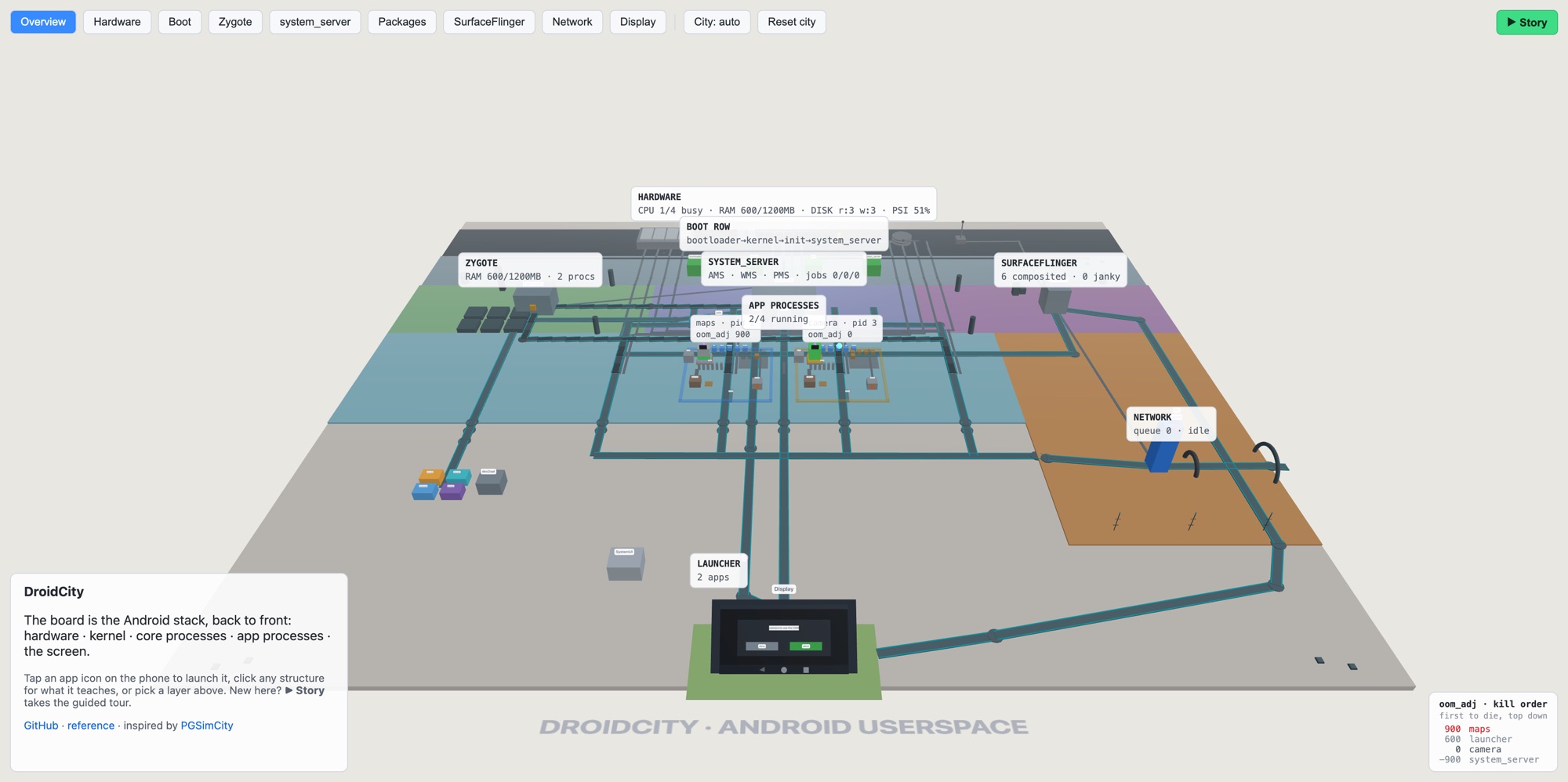
It’s a 3D city where the board itself is the Android stack, read north to south. The hardware strip sits at the top: CPU cores, the RAM bank, the disk, a radio mast. Below that, the boot row, bootloader to kernel to init to system_server. Then the core processes: Zygote as a foundry that stamps out new processes, system_server as the city hall next door, SurfaceFlinger as the last stop every frame makes before reaching the glass. Every running app rises as its own walled ward, and at the front edge there’s a phone screen that actually works.
That last part is the piece I care about most. The screen isn’t a picture of a launcher, it is the launcher. Tap an icon and the launch travels for real: the touch runs north to InputDispatcher inside system_server, the launcher files an Intent, ActivityManager approves it, Zygote forks, a new ward rises out of the ground, and its first frame lands back on the glass where you tapped. Press Back and the back stack actually pops. Open Recents and you get one card per live process.
Inside each ward the metaphor keeps going. The main road is the Looper, with the ANR watchdog riding it. The Activity tower rises through its lifecycle floors with a ViewModel sitting on the roof. There’s a heap yard where GC sweeps pass through, a render bench racing each frame to SurfaceFlinger, and a native workshop on the JNI bridge whose heap no garbage collector will ever touch. Hover anything and the tooltip tells you what the real Android mechanism is.
A few doors worth walking through first:
- A process is born, the full tap-to-first-frame launch as a narrated chapter
- The metal, where PSI pressure builds, kswapd compresses cold pages into zram, and lmkd finally picks a victim off the oom_adj ladder
- SurfaceFlinger, because most explanations of Android stop right before the part where pixels happen
- Play all, seven chapters in slow motion, boot to sleep
My favorite thing to show people is the memory ladder. Open any ward, press Allocate 150MB a few times, and watch what Android actually does under pressure. It doesn’t jump to a kill. Reclaim runs first, zram fills with diminishing returns, and only when reclaim can’t keep up does lmkd walk the kill order, which is displayed live in the corner the whole time. Watching cached wards get demolished in oom_adj order teaches more than any documentation page I’ve found on the subject.
I’ll be honest about what this is: an early prototype that simplifies aggressively. The city takes liberties with timing, collapses some flows, and certainly contains mistakes. I keep an audit of what’s modeled faithfully, what’s simplified on purpose, and what’s missing entirely in the reference doc. If you know Android internals and spot a tooltip or a flow that’s wrong, open an issue and tell me what the real behavior is. Corrections are the most useful contribution this project can get.
Start with the full tour. It runs in slow motion so the city keeps pace with the narration, and by chapter three you’ll know why I couldn’t leave this as a stack of boxes.